BaZi Benchmark
Tian Mira vs BaZi Calculator
A technical case study on true solar time, the four pillars and Day Master strength.
Study summary
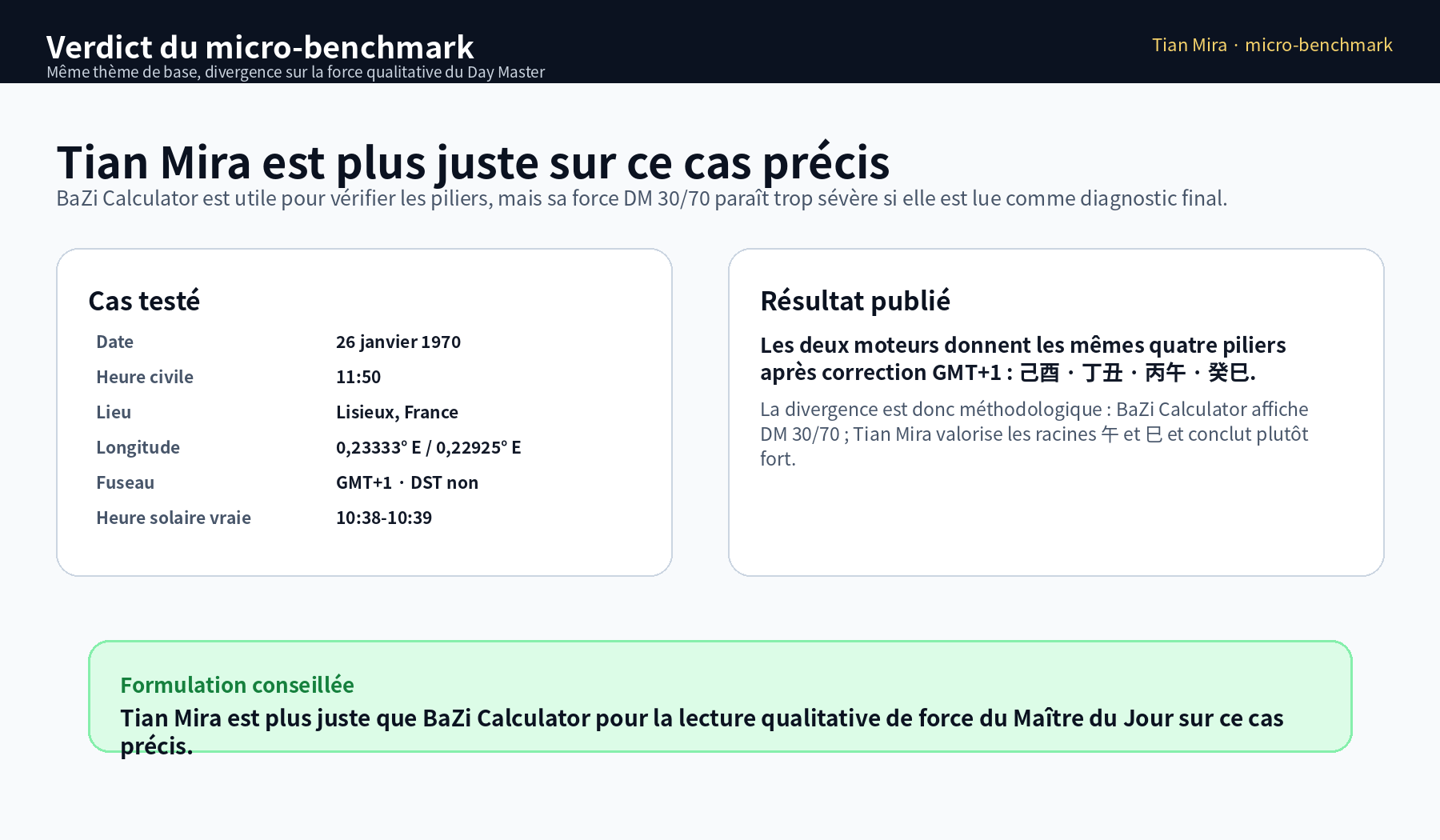
This study compares the engine results of Tian Mira and BaZi Calculator on the same birth case: Lisieux, France, January 26, 1970, 11:50.
After time zone correction and true solar time adjustment, both engines produce the same four pillars. The divergence is not about the base chart, but about how each engine evaluates the Day Master 丙 Bing's strength.
Study verdict: BaZi Calculator is correct on the four pillars, but its Day Master strength reading appears too severe in this case. Tian Mira is more accurate because it values the quality of the 午 and 巳 roots.
Input data for both engines
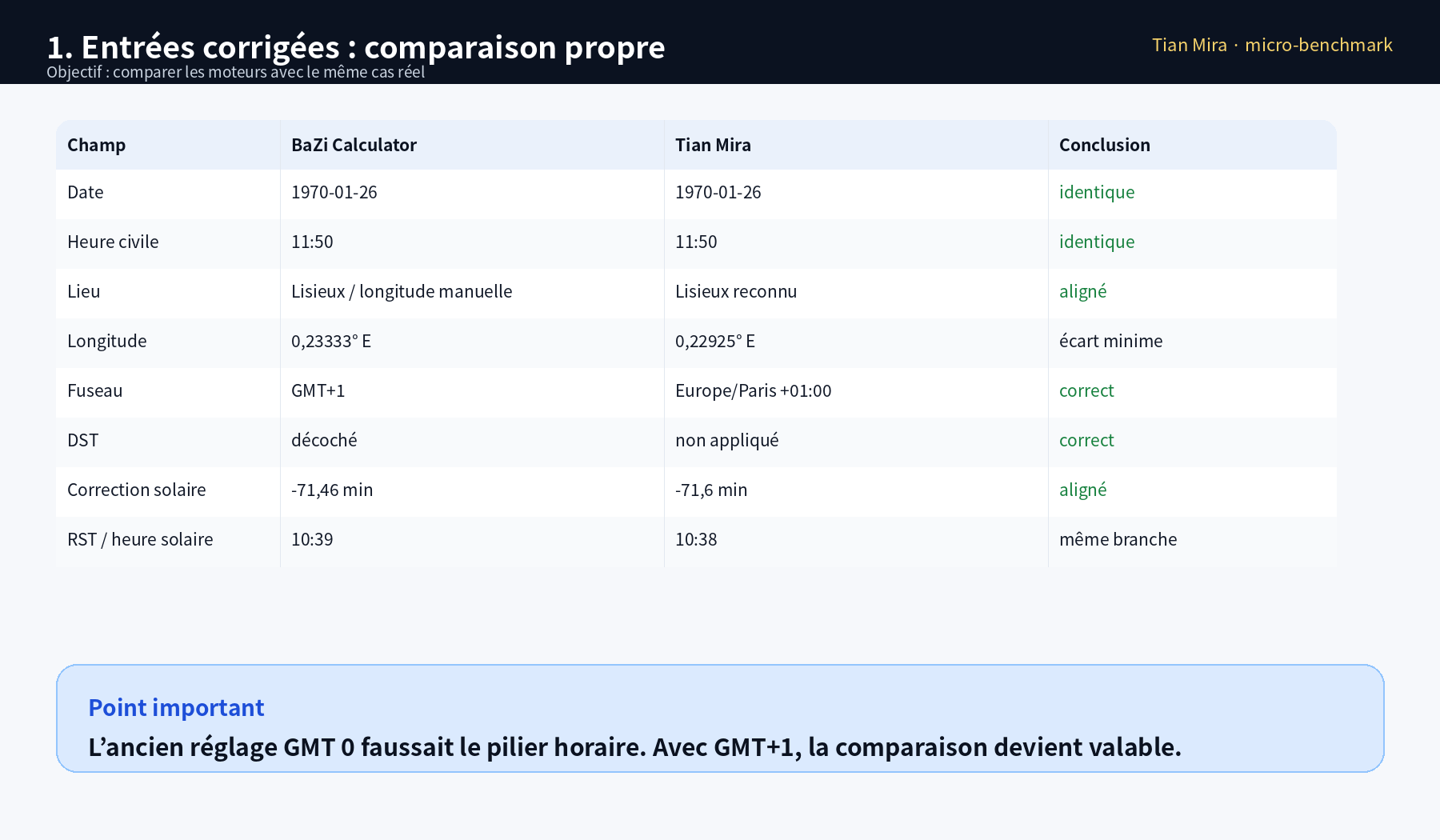
The tested case uses the exact parameters below. The first mistake to avoid is entering GMT 0 for a birth in France in January 1970. The correct setting is GMT+1, without DST.
Tian Mira recognizes Lisieux, applies Europe/Paris, uses the historical +01:00 offset, computes a solar correction of approximately -72 minutes, and obtains a true solar time of 10:38. The hour pillar shifts from 午 to 巳 when this correction is applied.
| Parameter | Value |
|---|---|
| Place | Lisieux, France |
| Date | January 26, 1970 |
| Civil time | 11:50 |
| Time zone | GMT+1 / Europe/Paris |
| DST | Not applied |
| Longitude | ≈ 0.23° East |
| True solar time | ≈ 10:38 |
| Solar correction | ≈ −72 min |
| Hour pillar change | 午 → 巳 |
Shared result: the same four pillars
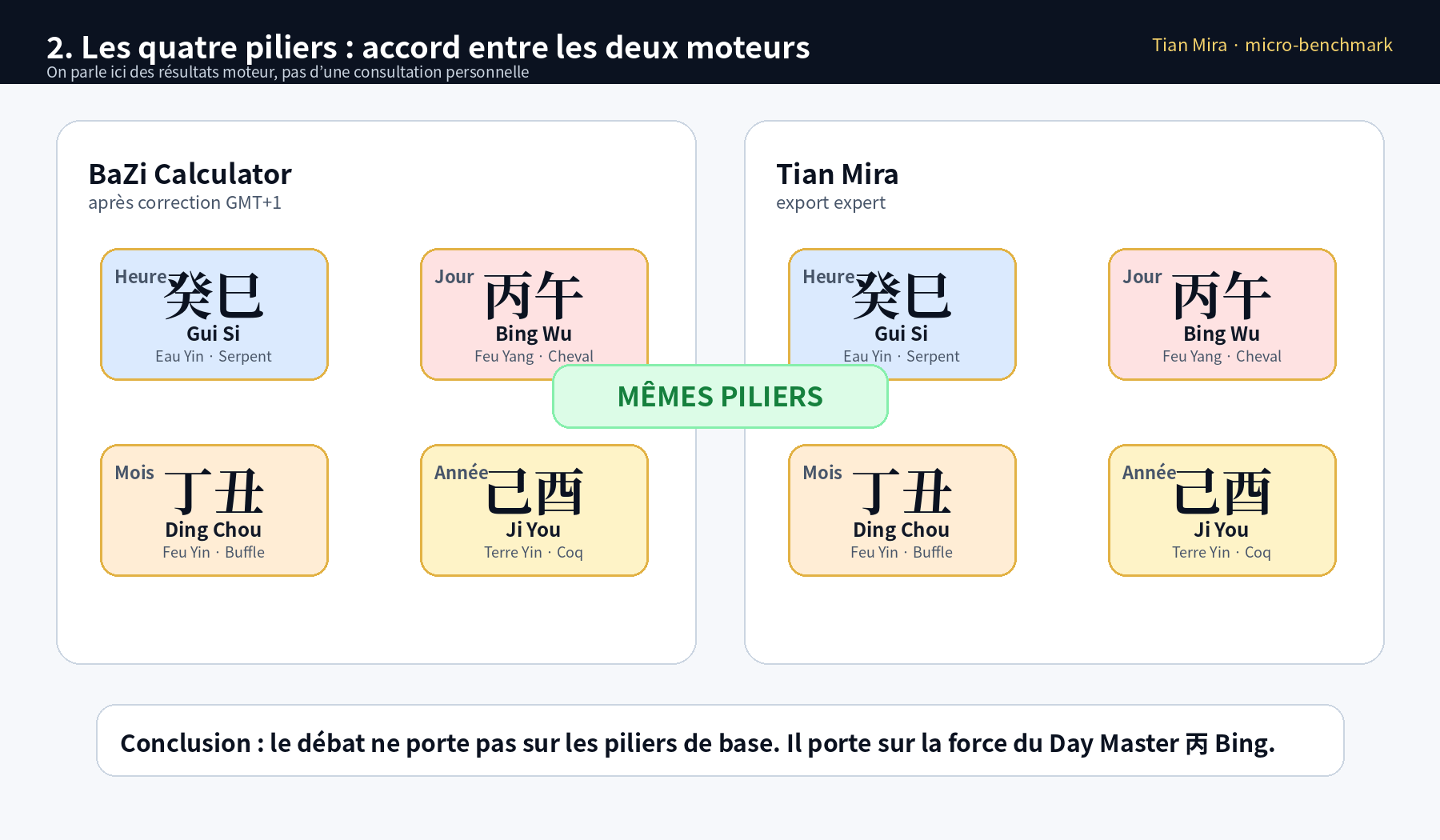
Once correctly configured, both engines agree on the four pillars. This part is essential: BaZi Calculator does not make mistakes on the pillars when properly configured. The serious comparison begins after: how does each engine evaluate Day Master strength?
| Pillar | Result |
|---|---|
| Year | 己酉 Ji You |
| Month | 丁丑 Ding Chou |
| Day | 丙午 Bing Wu |
| Hour | 癸巳 Gui Si |
Main divergence: Day Master strength
BaZi Calculator
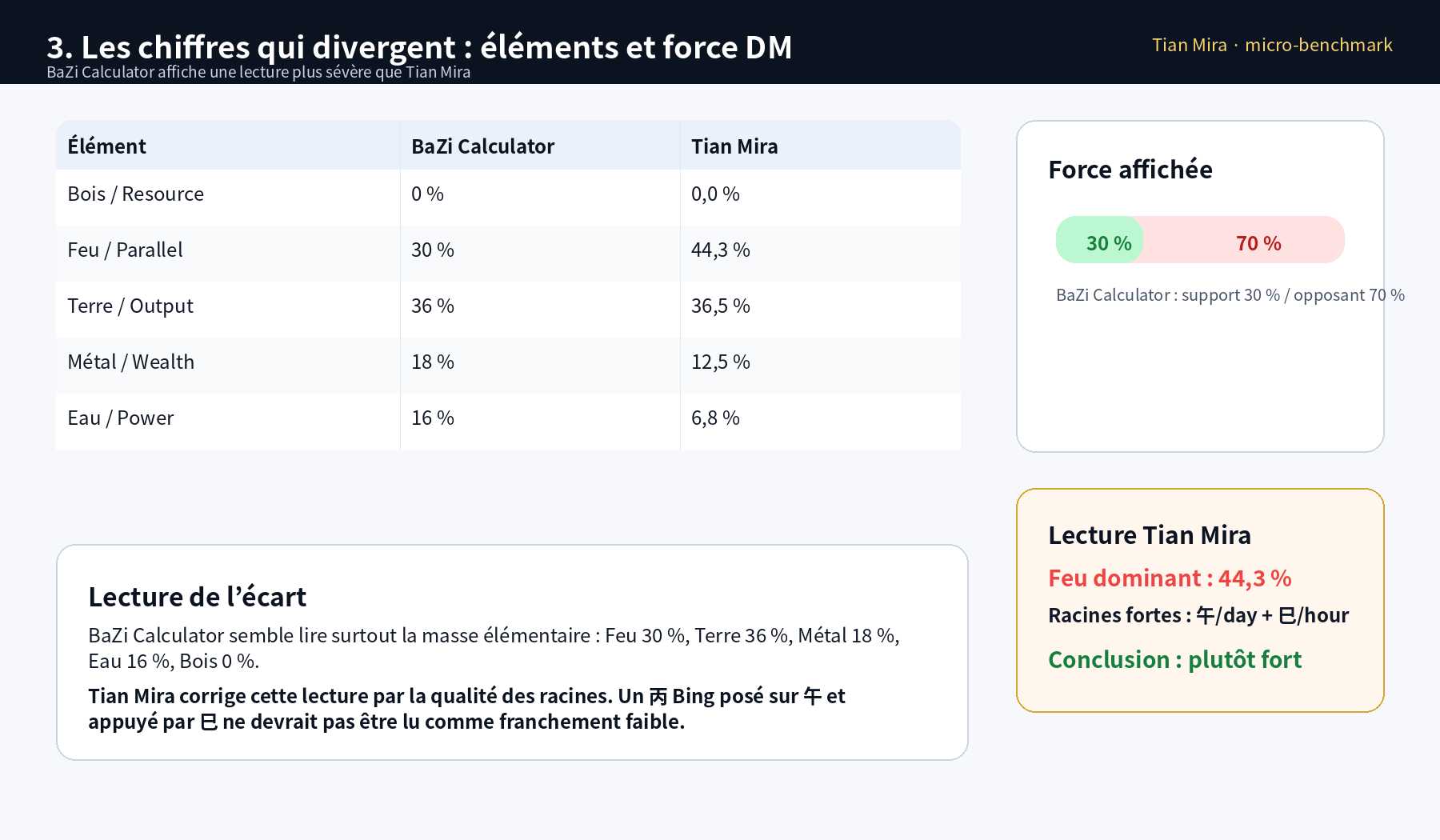
BaZi Calculator displays a highly numerical elemental breakdown. Fire is at 30%, Earth at 36%, Metal at 18%, and Water at 16%. Wood is at 0%.
Day Master strength is given as 30% support versus 70% opposing, suggesting a weak Day Master. This reading is mathematically consistent, but it underestimates the quality of the chart's roots.
Force DM : support 30 % / opposant 70 %
Tian Mira
Tian Mira displays Fire at 44.3%, Earth at 36.5%, Metal at 12.5%, Water at 6.8%, and Wood at 0%.
The Day Master is assessed as rather strong, with strong roots explicitly identified: 午 in the day pillar and 巳 in the hour pillar. The advanced V2 weighting values root quality over a simple mechanical sum of percentages.
The 月刃格 structure is presented as a candidate, not a definitive diagnosis. The 巳酉丑 → Metal triad is weighted cautiously, and transformations are not applied automatically.
Maître du Jour : plutôt fort
Racines fortes : 午/day, 巳/hour
Why Tian Mira is more accurate in this specific case
The Day Master is 丙 Bing, Yang Fire. In this chart, it is not isolated: it has two strong roots.
First root: 午 in the day pillar. The day pillar is 丙午 Bing Wu — the Day Master sits on 午, a very strong Fire branch. In BaZi logic, the day branch describes the Day Master's immediate seat.
Second root: 巳 in the hour pillar. The hour pillar is 癸巳 Gui Si. The 巳 branch also contains an important Fire root for Bing. Tian Mira explicitly identifies both roots in its technical export.
Consequence: a 丙 Bing seated on 午 and supported by 巳 should not be classified as plainly weak. This is why Tian Mira is more accurate in this specific case. BaZi Calculator sums percentages without sufficiently valuing the quality of classical roots.

Cautious verdict
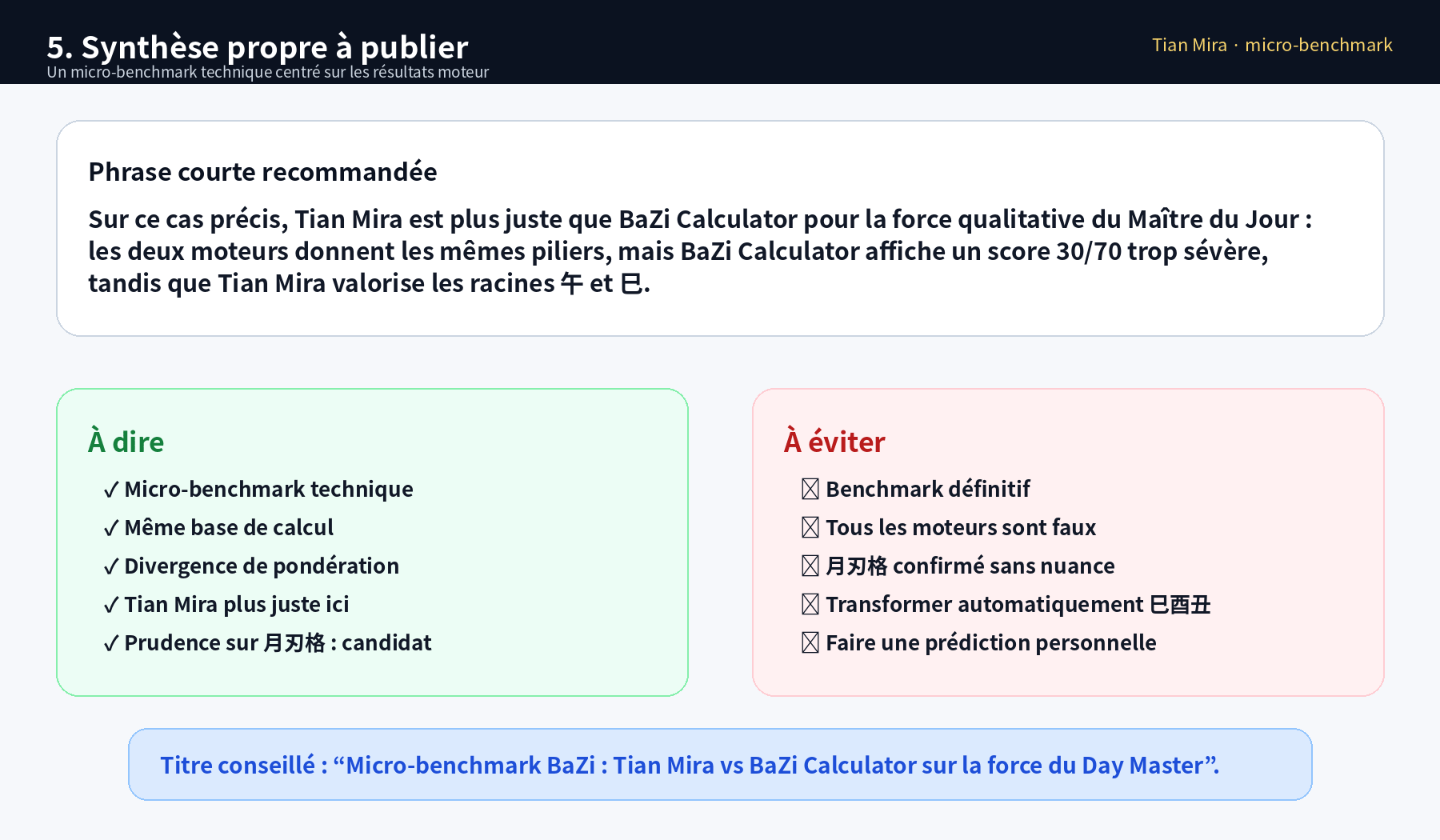
In this specific case, Tian Mira is more accurate than BaZi Calculator for the qualitative Day Master strength: both engines produce the same pillars, but BaZi Calculator shows a too-severe 30/70 score, while Tian Mira values the 午 and 巳 roots.
Methodological limits
This study is a micro-benchmark, not a definitive benchmark. It covers a single birth case.
To build a truly complete benchmark, one would need: several dates near solar month changes, several locations and longitudes, several cases with DST or historical time zone changes, several profiles with weak, strong and ambiguous Day Masters, and several Chinese and Western engines.
But as a case study, this test is useful: it precisely shows that an engine can compute the pillars correctly while giving a questionable strength reading.
Publishable conclusion
BaZi Calculator is correct on the four pillars, but too severe on Day Master strength. Tian Mira is more accurate in this case because it accounts for the quality of the 午 and 巳 roots, with explicit methodological caution.